At the rental counter, everything is designed to feel fast, smooth, and “handled.” You sign, you swipe, you grab keys, and you’re already mentally on the highway. But the truth is, car rental safety isn’t something you can outsource completely—even to the biggest brands. A rental fleet can be newer than the average car on the road, and still hide problems that turn a trip into a roadside nightmare. Just ask Josie Daigle, who rented a car in Boston, did a quick look-over, and hit the road with her two kids—only to suffer a tire blowout later because the tread was basically gone. The tow driver couldn’t believe the car had been handed out like that.
That gap—between what a company promises and the vehicle condition you actually receive—is exactly why a rental car inspection matters. It’s not only about avoiding surprise charges; it’s about preventing preventable risk. A few minutes spent checking tires, lights, warnings, paperwork, and tech can save hours (or worse) later. And if anything seems off, knowing what to say and how to document it can help you avoid rental disputes and get a safe replacement immediately.
- 🧾 Do a real rental car inspection before leaving: tires, lights, dashboard warnings, glass, and basic fluids.
- 🛞 Tires are non-negotiable: low tread and low pressure are common trip-ruiners and can cause blowouts.
- 📸 Document everything: photos + notes create your strongest shield to avoid rental disputes.
- 🔎 Run the VIN for recalls: it takes a minute and can prevent you from driving a car with an open safety defect.
- 🛡️ Know your insurance protection: understand deductibles, exclusions, and what the rental agreement really says.
- 🚫 If you feel unsafe, speak up: return immediately and demand another vehicle—don’t “hope it’s fine.”
Why a rental car inspection matters for car rental safety (and not just paperwork)
It’s easy to assume a rental car is automatically safe because it came from a professional company. That assumption is exactly what makes people vulnerable. The rental process is optimized for speed: lines are long, travelers are tired, and the staff is focused on turning vehicles around quickly. In that environment, small issues slip through—sometimes with big consequences.
Josie Daigle’s blowout story is the kind of thing that sticks because it’s so normal at the start. She wasn’t reckless. She did what most people do: a quick walk-around, maybe a glance at the fuel gauge, then off to the destination. The tire failure wasn’t just inconvenient; it was a serious safety hazard. A bald tire at highway speed, especially with kids in the back, can become a crash scenario in seconds. That’s the uncomfortable truth: car rental safety isn’t guaranteed by branding.
Industry experts have pointed out that rental brands have strong incentives to avoid renting unsafe vehicles—legal liability alone is huge. But incentives aren’t the same as perfection. The U.S. rental car industry doesn’t publish standardized national safety reporting for customers in a way that’s easy to compare. Some companies highlight features like backup cameras or parking sensors, but those are not the same as transparent, consistent inspection records.
The “newer than average” myth: newer cars can still be risky
Rental fleets are often younger than privately owned vehicles. One industry poll found the average car on the road is around 13 years old, while many rental companies rotate vehicles out around the 45,000–60,000-mile mark. That sounds reassuring—and it can be. Newer vehicles typically have better crash tech, better fuel economy, and fewer worn parts.
But mileage isn’t the only factor. A car can be “new-ish” and still suffer from hard use: curb hits, potholes, rushed cleanings, missed tire rotations, or a previous renter who drove 300 miles on a low-pressure tire. If you’ve ever seen someone treat a rental like a disposable object, you already get it. The point is not to panic; it’s to do a quick pre-drive inspection that matches reality.
Safety and money are tangled together
There’s a second reason this matters: disputes. A lot of rental arguments come from damage claims after return. Older research often cited that a large share of disputes involved undisclosed damage—regardless of the exact percentage, the pattern hasn’t vanished in 2026 because rentals move fast and documentation is inconsistent. A careful damage check, plus proof, is how you protect yourself and keep the trip from ending with angry emails and “evidence reviews.”
Think of a rental car inspection as two shields in one: a physical safety shield and a financial shield. The next step is knowing what to check—and how to do it quickly without looking like you’re trying to perform a full mechanical exam.
To make this practical, let’s get visual and specific.
Pre-drive inspection checklist: the non-negotiables before you leave the lot
Here’s the mindset: you’re not trying to be a mechanic—you’re trying to catch the obvious stuff that causes accidents, breakdowns, or billing fights. A good rental car checklist should take about 7–12 minutes if you’re focused, and it gets faster the more you do it.
I like to think of it as a loop: outside → tires → glass/lights → inside → start-up scan → short test roll. If you follow the same order every time, you won’t forget something important when you’re jet-lagged or traveling with kids.
Exterior damage check: protect yourself from surprise charges
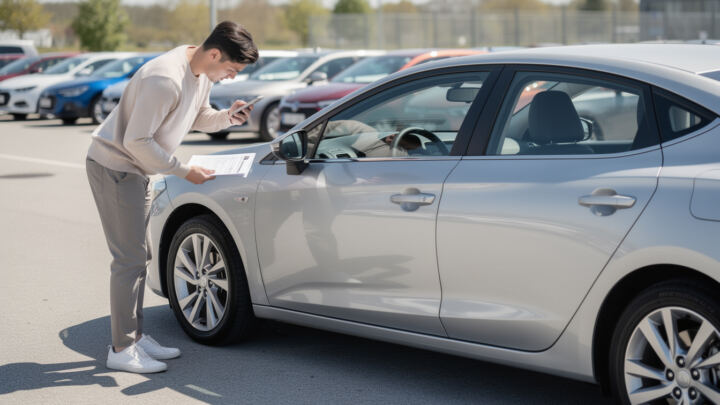
Start with a slow walk-around. Look for dents, scratches, paint transfer, misaligned panels, and scuffed wheels. Don’t ignore “small” marks—those are the ones that turn into email disputes later. Make your damage check boringly thorough.
Take photos from each corner (front-left, front-right, rear-left, rear-right), then close-ups of anything questionable. Also take a quick shot of the roof if you can safely see it—hail dents happen, and people rarely check up there. This documentation becomes the foundation of your rental car damage report if someone tries to claim you caused pre-existing issues.
Tires: the single fastest way to spot danger 🛞
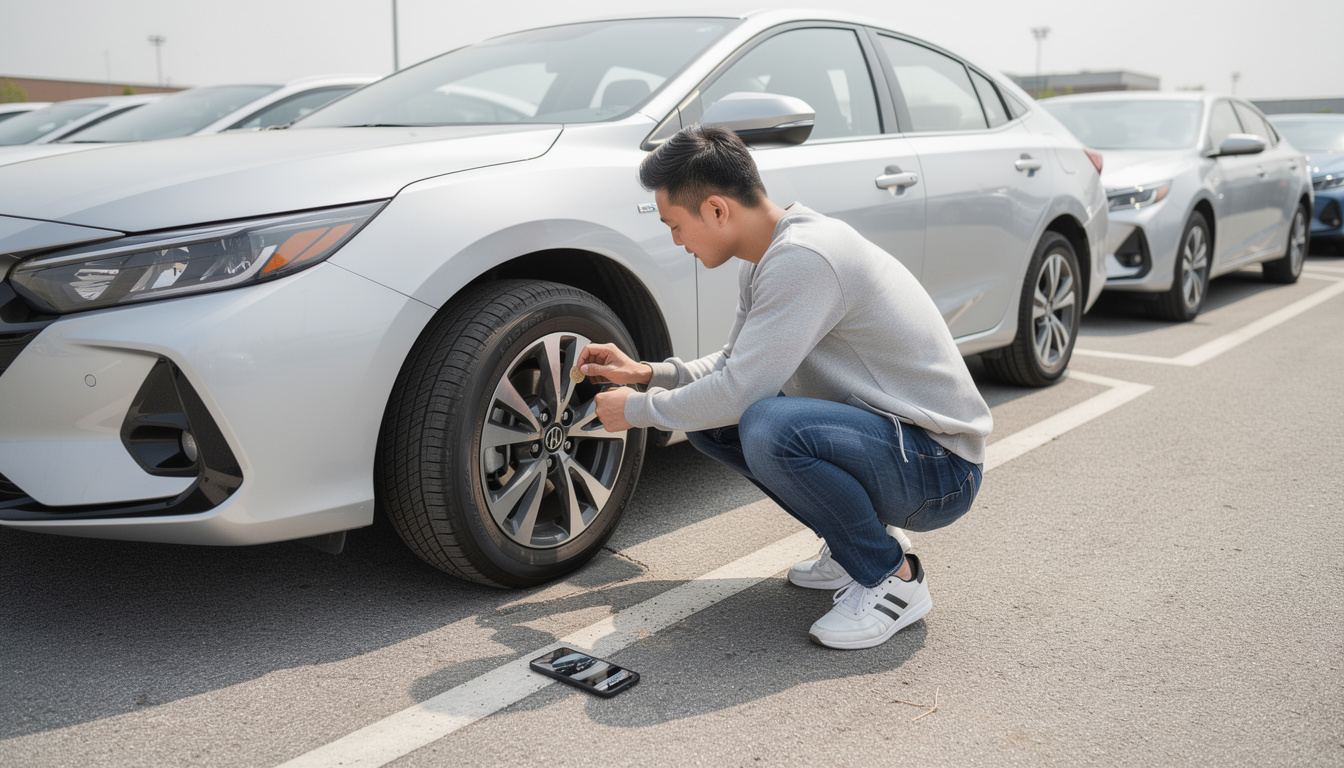
Tires are where most travelers should spend extra attention, because they’re both a safety item and a common weak spot. Look for uneven wear, bald patches, sidewall bulges, and embedded nails. If the tire looks “shaved,” don’t rationalize it—ask for another car.
You can do a simple tread check using a coin test (the exact coin varies by country, but the logic is the same). If the tread is so low that the wear bars are nearly flush, treat that like a red flag. Also check the pressure warning light after you start the car. A low-pressure alert might be minor, or it might be the start of a slow leak that becomes your problem 200 miles later.
Josie Daigle’s experience is the cautionary tale here: a quick glance didn’t reveal the seriousness, but a slightly closer look could have. Tires are not the place to be polite.
Glass, lights, and signals: visibility is safety 🚦
Check the windshield carefully for chips and cracks—especially near the edges where cracks spread. Do it in daylight if possible; angle changes help reveal damage. Even small chips can spiderweb quickly with temperature swings or highway vibration.
Then do a light check: headlights, brake lights, turn signals, and hazards. If you’re solo, back up near a wall to see reflections, or ask an agent to confirm. At night or in rain, working lights aren’t optional—they’re your communication with everyone else on the road.
Quick interior scan: seatbelts, mirrors, and “where is everything?”
Inside the cabin, check that seatbelts latch and retract smoothly. Seatbelts reduce fatal injury risk dramatically, but only if they actually work and sit correctly. Adjust mirrors, confirm the seat adjusters aren’t stuck, and make sure the steering wheel position feels natural.
Test climate control for 20–30 seconds. A broken A/C might not sound like a safety issue until you’re driving through a heat wave and fatigue hits faster. Also verify wipers and washer spray—visibility failures in sudden rain are a classic “why didn’t I check that?” moment.
A simple table you can follow in the lot
| Checkpoint ✅ | What you’re looking for 🔎 | Why it matters ⚠️ | Proof to capture 📸 |
|---|---|---|---|
| 🛞 Tires | Low tread, bulges, low pressure warning | Blowouts, hydroplaning, loss of control | Photo of each tire + dash warning if lit |
| 🚗 Body panels | Dents, scratches, wheel scuffs | Helps avoid rental disputes | Corner photos + close-ups |
| 💡 Lights | Headlights, signals, brake lights | Visibility + legal compliance | Short video or confirmation photo |
| 🪟 Windshield | Chips, cracks, pitting | Cracks spread; visibility loss | Close-up with angle |
| 🧾 Documents | Registration/required papers present | Avoid roadside hassle | Photo of glovebox contents list (no personal data) |
Once the car “passes” this baseline, you’re ready for the next level: startup warnings, recalls, and the stuff rental contracts don’t remind you to check.
Seeing someone do this step-by-step helps, so here’s a video search worth pulling up while you wait at the lot.
Paperwork, recalls, and insurance protection: the boring stuff that saves your trip
This is the part people rush because it feels less urgent than checking tires. But paperwork and safety databases are where you catch the “quiet” risks—like an open recall, an insurance mismatch, or a fuel policy trap that quietly adds $70 to your bill.
Start by matching the car to the contract. Verify the license plate and the vehicle class. Confirm the fuel policy in plain language. If you’re tired and in a hurry, this is exactly when expensive misunderstandings happen.
Recall check with the VIN: a one-minute habit with huge upside 🔎
Open recalls are not theoretical. They can involve airbags, braking systems, steering components, or software. In the U.S., the NHTSA database lets you search by VIN. It’s fast. If you’re renting outside the U.S., look for the local equivalent (many countries have manufacturer portals or transport authority databases).
The practical move: once you’re seated, find the VIN (often at the base of the windshield or inside the driver door jamb), type it into the database, and screenshot the result. It’s not paranoid; it’s a smart, lightweight️+10-second layer of insurance protection for your own body.
Rental agreement reality check: what you’re actually on the hook for
Some contracts are written clearly; some feel like a maze. Either way, a few lines matter a lot: damage responsibility, deductible amounts, excluded use (gravel roads, off-roading, certain countries/states), and the process if the vehicle breaks down.
If your card offers coverage, confirm whether it’s primary or secondary and what vehicle types are excluded. Many premium travel cards don’t cover exotic cars, some don’t cover certain SUVs, and plenty require you to decline the rental company’s collision coverage. That’s not a reason to skip coverage—it’s a reason to understand your insurance protection before you roll out.
Fuel policy: the sneakiest “gotcha” that feels like a punishment ⛽
Most renters do best with full-to-full: pick up full, return full. It’s usually cheaper than paying the company’s refuel rate, which can be dramatically above local prices. Take a photo of the fuel gauge at pickup and return. That’s it—two photos that prevent a whole argument later.
If you choose a prepay option, do it because it suits your route (like a super early airport drop-off where finding gas is a pain), not because you were rushed at the counter. Convenience is real, but so is the markup.
Proof-of-condition habits that reduce conflict
When you combine the contract checks with photos, you build a simple “evidence packet.” If you ever need to file a rental car damage report, you’re not reconstructing your memory—you’re showing timestamps.
- 📸 Photo of the fuel gauge at pickup
- 📸 Photo of the odometer at pickup
- 📸 Walk-around video (20 seconds) showing each side
- 🧾 Screenshot of recall check result
- 📝 Quick note in your phone: date/time, lot location, any issues reported
With the “boring” details handled, you’re ready for the part that actually decides how the car feels: the first start, the warning lights, and the mini test drive that catches brake or steering weirdness early.
If you want a quick demo on the VIN/recall idea and inspection flow, this is another helpful video search to keep handy.
How to spot unsafe vehicle condition fast: tires, brakes, warning lights, and weird vibes
Some problems scream; others whisper. The trick is learning the few signals that matter most, especially when you’re leaving a crowded airport garage and everything feels chaotic. Your goal is to catch “nope” issues early—before you’re merging into fast traffic.
Dashboard warning lights: don’t normalize them
When you start the car, every light should flash briefly and then turn off. If a warning stays on—check engine, tire pressure, ABS, traction control—ask what it means. Sometimes it’s minor. Sometimes it’s the car telling you the safety net is missing.
Here’s a simple rule: if the staff dismisses a warning as “it’s always on,” you don’t argue—you request a different car. You’re not paying to gamble with electronics that affect braking and stability.
Brake feel and steering feel: your 60-second test
Before you exit the lot, do a slow roll and a few gentle brake applications. The pedal should feel firm, not spongy or sinking. You shouldn’t hear grinding or feel vibration that screams “warped rotors.”
Then do a low-speed steering check. If the wheel is off-center while driving straight, or the car pulls hard to one side, that could be alignment, tire pressure imbalance, or suspension issues. None of those are your job to diagnose—but they are your job to refuse.
Wipers, washers, and defrost: underrated safety gear 🌧️
If you’re driving in winter conditions or through mountain passes, test defrost immediately. If the blower is weak or the windshield fogs and won’t clear, your visibility can vanish fast. Washer fluid matters too; in snowy slush, it’s the difference between seeing lane markings or guessing.
A quick story that happens more than people admit
Picture a fictional traveler, Maya, landing late in Denver for a weekend wedding. She’s tired, it’s cold, and she just wants to get to the hotel. She starts her rental and sees a low tire pressure alert. The counter is busy, so she shrugs and drives off. Forty minutes later, the alert turns into a serious wobble: a slow leak becomes a near-flat on the shoulder.
Now she’s not just late—she’s stuck managing a swap at night, possibly paying for an Uber, and wondering whether the tire damage will be blamed on her. If she’d handled it at the lot, she likely would’ve been handed another set of keys in minutes. That’s the power of a real pre-drive inspection: you fix problems while you still have leverage.
Equipment check: the stuff you’ll wish you had later
Ask where the spare tire or inflator kit is. Confirm there’s a jack if the car uses a spare. Look for basic emergency items if they’re supposed to be included. You don’t need a doomsday kit—just the basics that keep a minor issue from becoming a disaster.
Next up: what to do when the car fails the inspection, how to talk to staff, and how to insist on safety without turning it into a fight.
What to do if your rental feels unsafe: how to speak up, swap cars, and avoid rental disputes
There’s a moment a lot of people hesitate: you notice something off, but you don’t want to be “that customer.” Here’s the reality: being polite won’t protect you during a blowout, and it won’t protect your wallet if damage gets pinned on you. You can be calm and firm at the same time.
At the lot: the best time to solve it
If you haven’t left yet, you’re in the strongest position. Show the issue, request documentation, and ask for a replacement. Keep the conversation simple: “I’m not comfortable driving this. I need another vehicle.”
If you see bald tread, bulges, or a warning light, you don’t need to “prove” danger. Those are basic red flags. In Josie Daigle’s case, the replacement vehicle even flagged low tire pressure—she learned to refuse the second car and demand a third. That’s not being difficult; that’s being alive.
If you notice the issue after you leave: turn around (seriously)
If something feels wrong while driving—brakes, steering, overheating smell, new warning lights—return immediately if you can do so safely. Don’t push through the day hoping it holds. Call the company using the number on the agreement, explain the safety concern, and ask for instructions.
A good script helps when you’re stressed:
“I’m experiencing a safety issue (describe it). I’m returning now / I’m pulled over. I need a safe replacement vehicle immediately and I need this concern documented on my rental.”
How to build a clean rental car damage report
When there’s a swap or incident, your goal is a paper trail. Ask staff to note the issue in the system and provide a printed or emailed confirmation. Take photos of the dashboard warnings and the problem area. If a tow truck arrives, note the driver’s name/company if possible and what they observed (like “tread extremely worn”). Those third-party observations can be powerful if a dispute shows up later.
Dispute-proofing: habits that save hours later 🧾
- 📸 Take timestamped photos at pickup and drop-off (same angles if possible).
- 🧍 Ask an agent to confirm any existing damage in writing before you leave.
- 🧼 Photograph interior stains too—spills and tears can become your problem.
- 🛡️ Keep receipts for any fuel you buy right before return (helps with fuel disputes).
- 📩 If something goes wrong, follow up by email so there’s a written record.
Car rental tips that keep the tone friendly but the standards high
The best approach is confident, not combative. You’re not accusing anyone of trying to trick you; you’re stating what you need to drive safely. Most staff will respond well to clarity. And if they don’t, that’s even more reason to insist on a swap.
By the time you’ve done the inspection, documentation, and a short test roll, you’re driving off with a car you actually trust. And that’s the whole point: the next miles should be about your trip, not about managing preventable problems.
How long should a pre-drive inspection take for a rental car?
Usually 7–12 minutes if you follow a simple loop: exterior walk-around, tire check, lights/glass, interior basics, then a quick start-up scan. If you’re traveling with family or heading into bad weather, add a couple extra minutes for tires and wipers. ⏱️
What’s the single most important item on a rental car checklist?
Tires. 🛞 Low tread, sidewall bulges, or a tire pressure warning can turn into a blowout or loss of control, especially in rain. If the tires look questionable, ask for another car—no debate needed.
How do I avoid rental disputes about damage I didn’t cause?
Do a thorough damage check at pickup, take photos/video from multiple angles, and make sure any marks are recorded by staff. Then repeat quick photos at return (including fuel gauge). This simple documentation makes it much easier to avoid rental disputes if a claim appears later. 📸
Should I check for recalls on a rental car?
Yes. Use the VIN to check for open safety recalls (in the U.S., the NHTSA database). It’s fast and can help you avoid driving a vehicle with an unresolved safety defect. 🔎
What should I do if the rental car feels unsafe after I’ve already left the lot?
Pull over somewhere safe, call the rental company, and request immediate instructions and a replacement. If the issue involves brakes, steering, or tires, don’t keep driving ‘to see if it improves.’ Ask for the concern to be documented and keep photos for your rental car damage report. 🧾