En bref
- 🕒 Build timing clarity with one “source of truth” for pick-up times and drop-off times (and stick to it).
- 📲 Tight communication beats last-second texts: confirmations, reminders, and change logs prevent “I thought you meant…” moments.
- 🚗 Smart transportation flow (zones, signage, one-way loops) cuts stress and reduces risky curbside improvisation.
- 📅 Better scheduling and time management (buffers, staggered windows, backup plans) helps families and staff stay sane.
- 🧾 Clear instructions for authorized pickups and exceptions keep kids safe and adults calm.
- 🤝 Strong coordination across school/daycare, parents, and caregivers is the difference between a smooth handoff and daily chaos.
The chaos rarely starts with something big. It’s usually small: a parent shows up at 2:45 because they remembered “early release,” while the class is still in art; a caregiver arrives at the right time but in the wrong lane; someone assumes “pick-up” means curbside when the school means “park and walk.” These micro-misunderstandings stack up fast, especially when everyone’s juggling work calendars, after-school activities, and traffic that seems to be allergic to moving.
In 2026, families lean on apps, group chats, and shared calendars more than ever, but more tools don’t automatically mean fewer mistakes. In fact, too many channels can create conflicting messages—one email says 3:10, the app says 3:15, and the paper flyer says “doors open at 3:05.” This is a practical guide to avoiding confusion around pick-up times and drop-off times, with real-world systems schools and families can actually maintain when life gets messy.
Timing Clarity for Pick-Up and Drop-Off Times: Set One Rulebook Everyone Can Follow
If you want fewer mix-ups, you need a shared “rulebook” that’s so clear nobody has to guess. The biggest hidden cause of confusion is not forgetfulness—it’s ambiguous timing. “After school” isn’t a time. “By 3” isn’t a plan. Even “3:15 pickup” can be unclear if it doesn’t specify whether that means in the car line, at the classroom door, or signed out and leaving campus.
Picture a fictional but painfully realistic family: Maya and Jordan co-parent their son, Eli. Jordan thinks pick-up is “when the bell rings.” Maya thinks it’s “when the teacher releases the child to an authorized adult.” The difference is five minutes on a good day and twenty minutes on a bad day—enough to trigger late fees at daycare, missed meetings, and frayed nerves. The fix isn’t “try harder.” The fix is timing clarity that defines the full handoff.
Define time windows, not just timestamps
Schools and daycares that reduce confusion usually stop treating the schedule like a single point in time. Instead, they define a window: for example, “Drop-off window: 8:00–8:15. Instruction begins at 8:20.” That single sentence lowers anxiety because parents understand what “late” actually means and where the flexibility is.
For pick-up, a window helps the staff too. “Pick-up window: 3:05–3:25. After 3:25, sign out at the office.” Now there’s a default path for late arrivals, and staff aren’t improvising curbside policies every afternoon.
Use a single “source of truth” for scheduling
Confusion thrives when multiple documents compete. Choose one primary channel (often the school management app) and make everything else point to it. Emails can say, “For the latest pick-up times, check the app.” Paper flyers can include a QR code to the same page. When a change happens—early dismissal, weather plan, assembly day—it gets updated once, in one place, with a timestamp.
This is where basic scheduling discipline pays off: you’re not adding work, you’re removing contradictions.
Make instructions “visual and concrete”
People don’t read walls of text when they’re stressed. A simple visual checklist at the top of your policy page reduces mistakes: “1) Enter from Oak St. 2) Stay in right lane. 3) Placard visible. 4) Kids released only when car stops at Cone #3.” These are instructions a tired adult can follow without doing mental math.
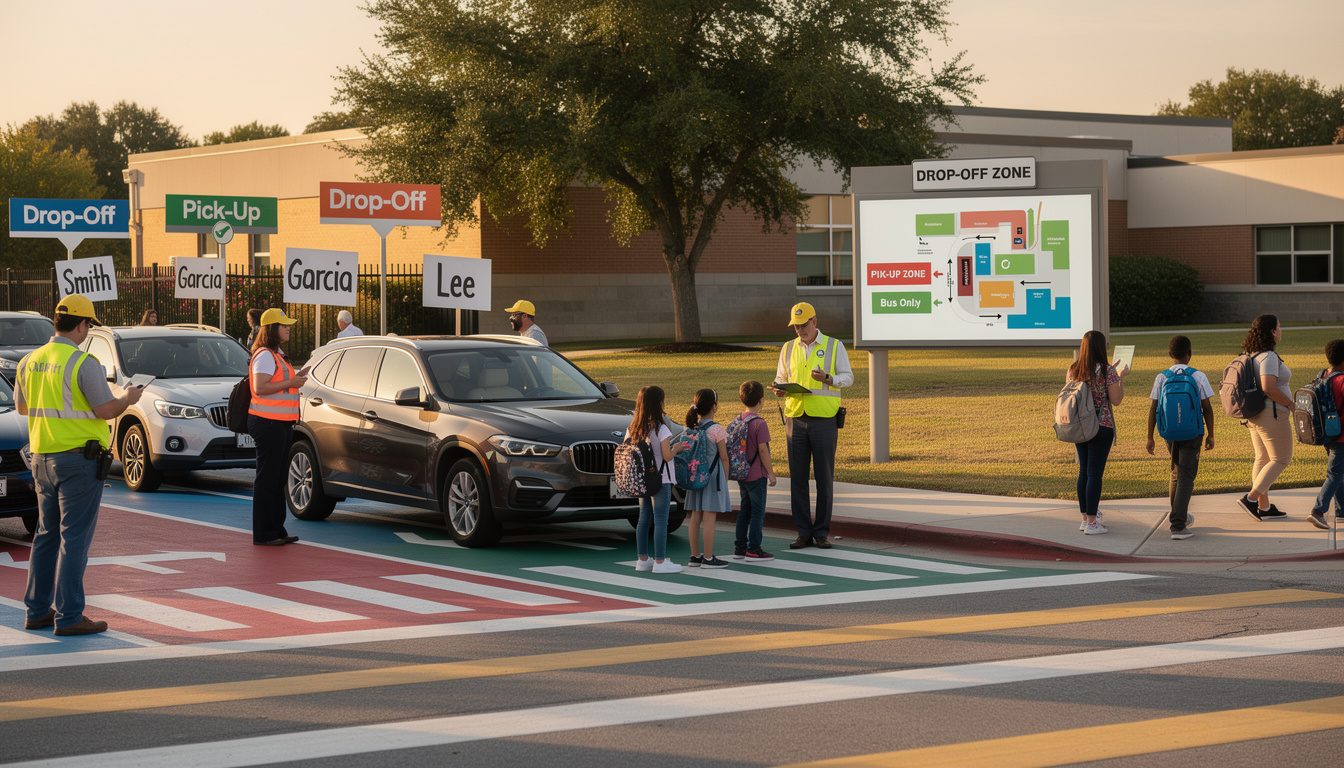
To make this tangible, some schools include a short, annotated map for transportation routes. It’s not fancy—just clear. The insight here is simple: if someone can’t explain your procedure in one breath, it’s too complicated.
Avoiding Confusion with Communication: Messages That Prevent “I Didn’t Know” Moments
You can have perfect policies and still get daily mix-ups if communication is sloppy. The problem isn’t that parents don’t care—it’s that they’re triaging information all day. So your messages have to be consistent, repeatable, and designed for real life.
Let’s go back to Maya and Jordan. They both love Eli, but they coordinate through three different channels: a co-parenting app, text messages, and occasional emails. A schedule change gets posted in one place, acknowledged in another, and forgotten in the third. Sound familiar? This is why “more communication” doesn’t help unless it’s structured.
Use a three-touch system for schedule changes
When a school adjusts drop-off times or early dismissal, the most effective approach is “announce, remind, confirm.” For example:
- 📣 Announcement: 72 hours before (email + app post with the new time and the reason).
- 🔔 Reminder: 24 hours before (short push notification: “Tomorrow pick-up begins at 2:30.”).
- ✅ Confirmation: day-of (morning message + a sign at the entrance).
This sounds repetitive, but it works because it meets people where they are. A parent might miss one message; missing all three is much less likely.
Keep wording stable to avoid accidental reinterpretation
One underrated trick: use the same phrasing every time. If you normally say “Pick-up window opens at 3:05,” don’t switch to “Children are dismissed at 3:05” for a special day. Parents will read different meanings into different verbs. Consistent language creates consistent behavior, and consistent behavior creates safer lines.
Log exceptions so everyone sees the same reality
Exceptions are where confusion explodes: a grandparent is picking up, a child goes home with a friend, a parent is stuck in traffic. In 2026, many schools use tools like PowerSchool or similar platforms, and some communities rely on apps like AHProof for verification and check-out flows. The tool matters less than the habit: every exception gets logged in one place.
Here’s the practical rule: if it’s important enough to text, it’s important enough to record. That protects kids and removes the “but I told someone” loop that burns staff time.
The next piece is where the rubber literally meets the road: the physical system. Even perfect messaging can’t fix a car line designed for half the current enrollment.
Transportation and Coordination: Designing Drop-Off and Pick-Up Flow That People Don’t Have to Guess
Traffic isn’t just annoying—it’s a safety issue. When cars bunch up, people start making creative decisions: U-turns, double-parking, waving kids across lanes. Organizations focused on road safety have long warned that delays and congestion increase the risk of collisions, and anyone who has watched a frantic curbside scene knows exactly why.
Good transportation flow reduces the need for last-second choices. It’s basically behavior design: if the easiest path is also the safest path, most people will follow it without being told twice.
Set up zones that match real family needs
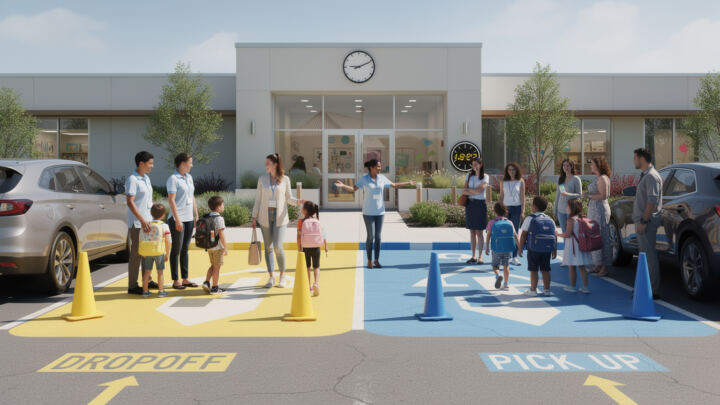
Many schools do better once they separate traffic into clear zones:
- 🚙 Quick curb drop-off: no parking, kids ready, doors open on the safe side.
- 🅿️ Park-and-walk: for families with multiple children, strollers, or forms to sign.
- 🚌 Bus loop: physically separated so buses aren’t trapped behind cars.
- ♿ Accessible zone: closer, wider, staffed, and protected from impatient shortcuts.
The key is enforcement with empathy. If a family clearly needs park-and-walk, don’t shame them for not doing curbside speed-runs. Design the system so they aren’t forced into the wrong lane.
Use one-way loops and “decision points”
Confusion spikes at intersections and merges. A one-way loop with simple “decision points” prevents mid-line lane changes. Signage should appear before the decision, not after it. Think: “Curb drop-off: keep right in 200 ft” rather than “Curb drop-off here” when it’s already too late.
Schools that revisit their traffic plan often see big improvements. It’s common in traffic management studies to find that organized flow can reduce wait times by around 30% when bottlenecks are removed and staff are positioned where decisions happen. That’s not magic—it’s just fewer conflict points.
Coordinate humans: staff, volunteers, and local authorities
Even the best layout needs people. Trained staff or parent volunteers can act as “flow coaches”: they point, they answer quick questions, and they keep the line moving without turning the place into a police state. If your campus borders busy streets, coordination with local authorities can help with temporary signage, crosswalk support, or adjusted turn restrictions during peak minutes.
| 🔎 Confusion hotspot | 😬 What usually happens | ✅ Fix that improves timing clarity | 🕒 Expected impact |
|---|---|---|---|
| 🚗 Merge point near entrance | Last-second lane changes and honking | One-way loop + early signage + cones | Shorter line, fewer near-misses |
| 🧒 Release point ambiguity | Kids waiting while adults argue about “where pickup is” | Numbered cones + “meet at Cone #3” instructions | Faster handoffs, calmer students |
| 🅿️ Parking lot overflow | Double-parking and blocked exits | Parking plan by grade/time window | More predictable movement |
| ♿ Accessibility pinch points | Families feel rushed or unsafe | Dedicated accessible zone + staff support | Inclusive, safer routines |
Once the physical flow is under control, the next big unlock is digital: the right tech can cut waiting and reduce disputes—if it’s implemented thoughtfully.
Scheduling and Time Management Tools: Apps, Check-Ins, and Buffers That Actually Work
Tech can either reduce friction or create new confusion. The difference is whether the tool supports the routine people already live with. Parents don’t want ten new buttons at 7:45 a.m. They want fewer steps, fewer surprises, and fewer moments where they have to explain themselves to three different adults.
Start with the most powerful idea in time management: build buffers like you actually mean it. If pick-up ends at 3:25, plan your personal arrival at 3:15. That ten-minute cushion is what keeps a minor traffic delay from becoming a full-blown scramble.
Digital sign-out reduces bottlenecks
Schools using digital sign-in/out tend to see fewer “paper pile” slowdowns. A parent can pre-register who is picking up, and staff can verify quickly. Platforms vary by district, but the functional benefits are consistent: fewer manual errors, better audit trails, and faster resolution when someone says, “I’m authorized, I swear.”
Some communities are experimenting with automated check-in, including facial recognition or QR-based systems. When done with strong consent practices and clear privacy rules, automated check-in can speed up the process and reduce the need for staff to interpret handwritten notes in a hurry.
GPS updates and real-time messaging (used carefully)
Real-time location tools can help with coordination, especially for buses or after-school shuttles. A simple “bus is 6 minutes away” notification changes the whole mood at the curb. Parents wait with less anxiety, and staff field fewer repetitive questions.
The trick is to avoid false precision. Don’t promise “arriving at 3:07” if traffic makes that unreliable. Use ranges: “Arriving in 5–10 minutes.” That’s honest, and it prevents disappointment-driven arguments.
Staggered times: the underrated scheduling win
Staggered start/end times can reduce the number of cars arriving at once. This is one of those ideas that sounds small until you see it working: kindergarten pick-up at 3:00, grades 1–2 at 3:10, grades 3–5 at 3:20. Suddenly, the line becomes manageable, parking becomes possible, and staff can focus on safety instead of crowd control.
For families, the trade-off is coordination across siblings. A workaround some schools use is a “family grouping” option where siblings are released together at the later time, paired with a supervised waiting area. It’s not perfect, but it’s practical.
Tools and schedules help, but the most delicate part remains human: emotions, custody logistics, and those awkward handoffs where kids feel the tension. That’s where the next section goes.
Avoiding Confusion in Real Life: Co-Parenting Handoffs, Daycare Policies, and High-Emotion Moments
Confusion isn’t always a calendar problem. Sometimes it’s an emotional problem wearing a scheduling costume. Co-parenting drop-offs can bring up grief, anger, or anxiety, and when adults feel activated, they misread messages, forget details, or interpret neutral policies as personal attacks.
Maya and Jordan, for example, agreed that Jordan handles Monday pick-up. One Monday, Jordan is late and texts, “Grab Eli at 3.” Maya reads it as “pick him up at 3:00,” but the school’s actual release window starts at 3:05. Maya arrives “on time” for her interpretation, then waits, then gets annoyed, then sends a heated message. A tiny mismatch becomes a conflict.
Write down the handoff definition (seriously)
If two households are involved, define pickup in one sentence: “Pickup means the child is signed out, in the car, and the school/daycare is no longer responsible.” That single definition prevents fights about whether someone was late when they arrived at the building but didn’t complete the release process.
Also define drop-off: “Drop-off means the child is checked in with staff (not just dropped at the curb).” These are boring sentences that prevent dramatic afternoons.
Authorized pickup protocols: calm, firm, consistent
Schools and daycares should stick to a strict authorized pickup list. It protects children and protects staff from manipulation. Parents should expect to show ID when it’s required—yes, even if “everyone knows me.” That norm reduces the chance of unauthorized access and lowers the pressure on staff to make judgment calls.
If a last-minute change happens, the best practice is a recorded update through the official channel, not a message “through the child,” not a sticky note, not a vague text. This is avoiding confusion and improving safety at the same time.
Create a “late plan” that doesn’t punish kids
Kids feel it when adults panic. A simple late plan removes the drama: “If we’re running behind, you’ll wait in the office with a book, and I’ll see you as soon as I can.” Schools can support this by having a consistent late-pickup procedure and communicating it without shame.
And yes, fees may exist, but the emotional tone matters. The system should encourage predictability, not humiliation.
Inclusivity: special needs and different family setups
For students with disabilities, the plan has to be more than “good luck.” Provide a designated area, trained staff support, and a clear process for mobility equipment, medical needs, or sensory-friendly transitions. Families should be invited to share what works—quiet waiting spots, earlier release, or a consistent staff member for handoff.
Different family structures matter too: grandparents, guardians, foster placements, and blended families all rely on crystal-clear instructions and consistent enforcement. The insight here is that clarity is kindness, especially when life is complicated.
What’s the simplest way to prevent mix-ups with pick-up times?
Use one official schedule source (usually a school app) and define pick-up as a full handoff: the child is released to an authorized adult, not just ‘the bell rang.’ Add a pick-up window (for example 3:05–3:25) so everyone knows what ‘on time’ means.
How do we handle last-minute changes without creating more confusion?
Use a three-touch communication pattern: announce the change early, send a short reminder the day before, and confirm day-of. Keep the wording consistent across messages and log any exceptions (alternate caregiver, different lane) in the same place every time.
What traffic changes make the biggest difference for drop-off times?
Clear zones (curb drop-off vs park-and-walk), one-way loops, and signage placed before decision points reduce guessing and risky maneuvers. Pair the layout with trained staff or volunteers so drivers get quick guidance without stopping the line.
Are digital check-ins worth it for time management?
Yes, if they reduce steps instead of adding them. Digital sign-out and pre-authorization can shorten waits and provide an audit trail for safety. Just make sure families know exactly where to check in, what the cutoff times are, and what happens when someone arrives late.
How can co-parents avoid arguments about scheduling and coordination?
Agree in writing on definitions (what counts as drop-off and pick-up), build buffers into arrival times, and use one shared channel for schedule updates. When emotions run high, a clear late plan and consistent procedures protect the child from adult stress.